A child psychologist's view on speech delay in kids
One of the most common questions parents bring in: why isn't my child talking? Some parents expect first words by their child's first birthday; others by age 2 or 3. And the doubt creeps in: do we wait, or is it time to see a specialist?
From the perspective of modern developmental theory, speech doesn't appear on its own. It's a layer built on top of more foundational functions: attention, perception, regulation, interaction, and communication with adults.
When a child isn't talking, the cause isn't always in the speech apparatus itself. Often, it's that the underlying skills speech depends on haven't fully formed yet.
By around the first year, in typical development, a child builds a set of foundational abilities: looking at an adult, sharing attention, understanding when they're addressed, taking initiative, using gestures, and engaging in contact.
It's on this communicative base that first words emerge. If that foundation isn't in place, speech may not appear at all, may stay formal, or may disappear — what's known as regression.
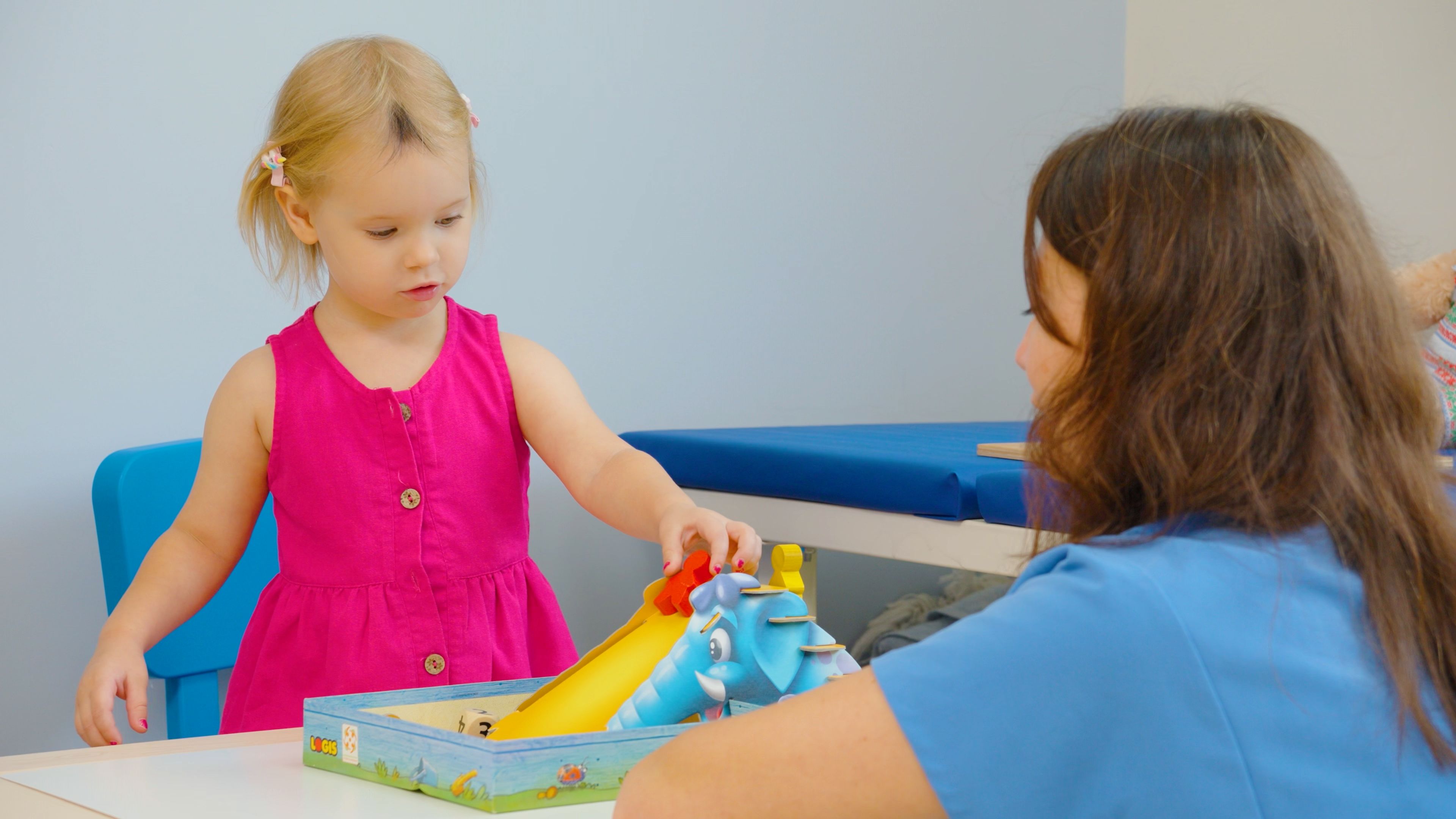
What needs to come before speech
There are important milestones that come before a child's first words.
In typical development, a child:
- Makes and holds eye contact
- Responds to their name
- Uses pointing gestures
- Shares interest ("look at this!")
- Pulls an adult toward an object
- Understands simple speech
- Reacts to emotions
Why a child may not be talking: 8 reasons
1. A slower pace of speech development
The child is developing more slowly, but their interest in communication is intact: they make eye contact, reach out, react to emotions. In this case, what matters is creating a rich language environment that supports development.
2. Communication difficulties
The child doesn't initiate contact, doesn't use gestures, doesn't share interest. Here, the work isn't only with speech itself — it's with the underlying desire to communicate.
3. Hearing factors
Even mild or temporary hearing loss — for example, after frequent ear infections or because of fluid in the middle ear — can affect speech development. The child can hear, but doesn't distinguish sounds clearly enough, which makes it harder to understand and reproduce words. That's why, with any speech delay, it's important to rule out hearing issues first.
4. A bilingual environment
In Dubai, children often grow up surrounded by several languages at once. Bilingualism on its own doesn't cause speech delay — but in a child with developmental vulnerabilities, it can amplify the difficulties: speech appears later, holding multiple language systems is harder, and communicative confidence drops.
5. Sensory differences
Heightened or reduced sensitivity can interfere with how a child takes in speech and engages with others. Holding attention, processing sounds, or staying in contact may be harder. In this case, what helps is mapping out the child's sensory profile and working through Sensory Integration therapy.
6. Difficulty understanding speech
Sometimes a child isn't talking because they don't yet understand the speech directed at them. When that's the case, building comprehension comes first — active speech follows.
7. Autism spectrum traits
If a child not only isn't talking but also doesn't make eye contact, doesn't respond to their name, and avoids contact — the silence may be only one part of a larger picture. In this case, it's important not to delay seeing a specialist.
8. A lack of live, real-time interaction
Speech develops in contact: through real play, joint attention, and emotional connection. When that kind of interaction is in short supply, it can slow speech development.
If a child hasn't built joint attention, interest in people, or comprehension of speech directed at them, words may not emerge — or may stay formal. That's why speech therapists often refer children to a psychologist or developmental specialist first, to build the foundational skills that speech rests on.

When it's time to see a specialist
- By age two, the child isn't speaking in two-word phrases, or has very few words
- Doesn't use gestures
- Doesn't respond to their name
- Doesn't point things out or share interest
- Avoids contact
- Speech was there and disappeared
- The parents have a sense that "something's off" — because parents read their own child better than any developmental chart.
Why it matters to act before age 3
Early childhood is the season of first words, first independence, first discoveries. But for many families, it's also a season of worry.
Why isn't my child talking? Is it normal that they avoid contact? Is this temperament, or a delay? Could this have anything to do with the autism spectrum? These questions come up more and more often as early as ages 1–3 — and that's no accident.
The first three years of life are the period of maximum brain plasticity. According to the Harvard University Center on the Developing Child, by age three a child's brain reaches roughly 80% of its adult volume. This is the window when the key neural connections form — the ones responsible for speech, social interaction, emotional regulation, and the capacity to learn.
If a child has a speech delay, signs of autism, or general developmental delay, this is the most effective age to start helping. At this stage, you can meaningfully shift the trajectory of development.
Why "let's wait" isn't always a safe strategy
Parents often hear: "they'll grow out of it," "boys just start talking later," "in a bilingual home, this is normal." Sometimes that's genuinely true.
But sometimes, behind those reassurances sits a whole spectrum of conditions: from a developmental delay in the pace of speech, to ADHD, to autism spectrum traits, to hearing impairment.
According to the Centers for Disease Control and Prevention, roughly 1 in 6 children has a developmental or behavioural difference.
How life in Dubai shapes early development
Dubai is a city of opportunity. But for a small child, it's also an environment with a heavier-than-usual adaptive load.
Many children grow up with two or three languages at once. A bilingual environment isn't harmful in itself, but in a child with developmental vulnerabilities it can intensify difficulties: delaying the start of speech, lowering communicative confidence, and triggering frustration when they aren't understood.
Changing countries, nurseries, and surroundings is a major stressor for a child's nervous system. In small children, this can show up as speech regression, more pronounced rituals, rising anxiety, and disrupted sleep and eating.
In early childhood, adaptation is directly tied to a sense of safety — and it's that sense of safety that underlies the development of regulation, attachment, and the ability to engage with the world.
There's also a separate factor: high academic expectations. In Dubai, children enter the world of competitive international schools early. If self-regulation, joint attention, and communicative initiative aren't in place by ages 3–4, adapting to a group format becomes significantly harder.
That's why early support isn't just about correction — it's also about preventing future learning difficulties.
This article is for informational purposes and is not a substitute for medical consultation. Decisions about diagnosis and treatment are made on a case-by-case basis, together with a specialist.
You can book a child psychology appointment in Dubai via WhatsApp or by phone at +971 456 312 00.