Why are vaccinations necessary and how does the vaccination schedule differ in Dubai


The UAE's child vaccination schedule has its own unique features, which are important to be aware of after moving. The local vaccination schedule may differ from what you're used to in your home country (including Russia), and may include a different list of mandatory vaccines, different schedules, and different medications. We'll explore why vaccinations are necessary, what makes the UAE's child vaccination schedule unique, and how to navigate the schedule.
Why Vaccination Is Necessary: The Answer in Numbers
Vaccination is one of the most significant achievements in medicine. According to a World Health Organization (WHO) study published in The Lancet in 2024, immunization programs have saved at least 154 million lives over 50 years. That's six lives every minute for five decades. The vast majority of those saved were infants and children under five.
Vaccines protect not only against the diseases themselves but also against their complications. For example, measles can lead to blindness, deafness, and brain damage in unvaccinated children. Whooping cough in infants under six months often results in intensive care. Meningococcal meningitis can be fatal in a matter of hours. Immunity to these diseases is not transmitted from a vaccinated mother—each child must complete the vaccination course independently.
However, parents often postpone vaccinations due to fears and prejudices. Kandinsky Clinic pediatricians Diana Abdrakhmanova and Vladislava Tkachenko answer frequently asked questions about vaccinations and the vaccination schedule for children in Dubai.
How does Dubai's vaccination plan differ from Russia's?
The UAE's childhood vaccination schedule is based on a local Ministry of Health order and differs from the Russian schedule in several key areas.
Some vaccinations in the schedule are mandatory, while others are optional. The table provides a visual comparison.
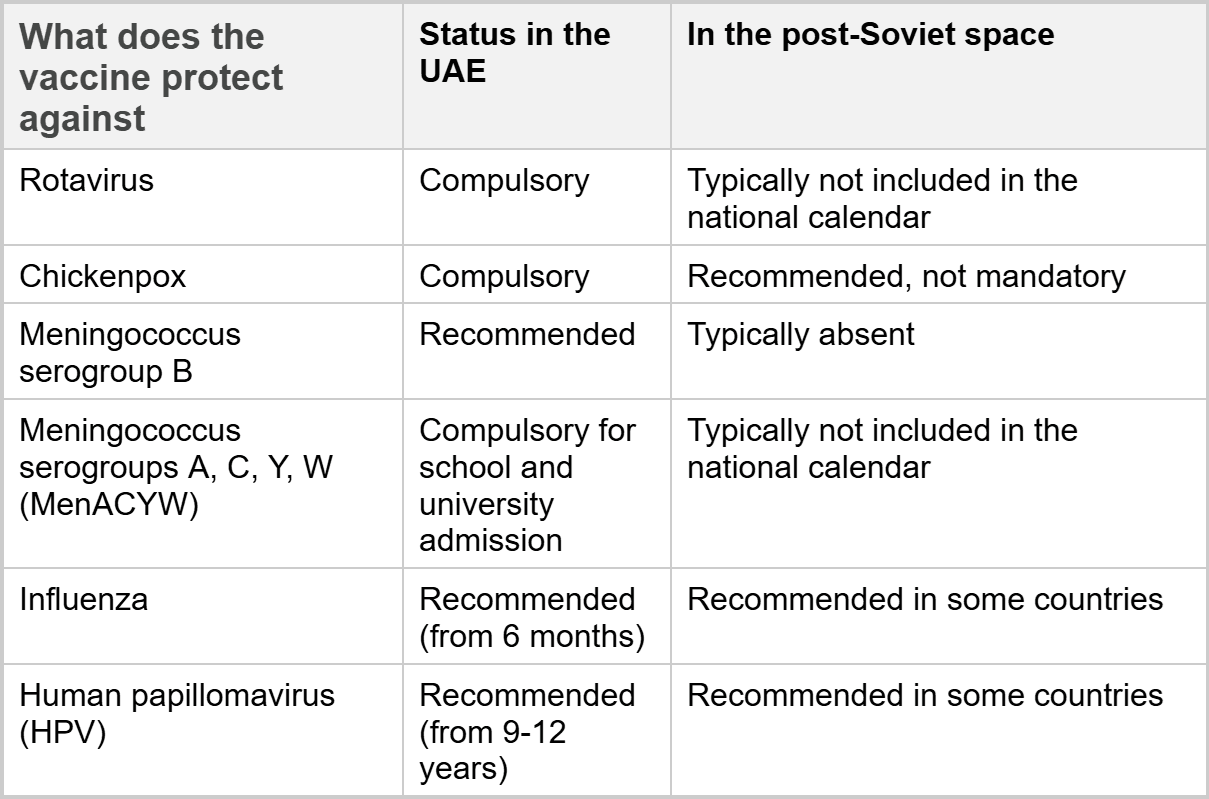
The list of mandatory vaccines in the UAE, included in most national calendars: BCG (tuberculosis), vaccines against hepatitis B, diphtheria, tetanus, whooping cough, polio, Haemophilus influenzae, pneumococcus, measles, rubella and mumps.
Vaccination of children under one year: schedule by age
The period from birth to one year is the most intense, during which a child is vaccinated against many infections. Below is the basic vaccination schedule for children in the UAE.
- In the first hours after birth: BCG and hepatitis B
- At two months: hexavalent vaccine (diphtheria, tetanus, pertussis, Haemophilus influenzae, polio, hepatitis B), pneumococcal, rotavirus
- At four months: booster doses of the hexavalent vaccine, pneumococcal, and rotavirus
- At six months: pentavalent vaccine (diphtheria, tetanus, pertussis, Haemophilus influenzae type b, hepatitis B) and oral polio vaccine (OPV), rotavirus — depending on the chosen product's schedule
- At one year: measles, rubella, mumps, chickenpox, and the first dose of MenACWY
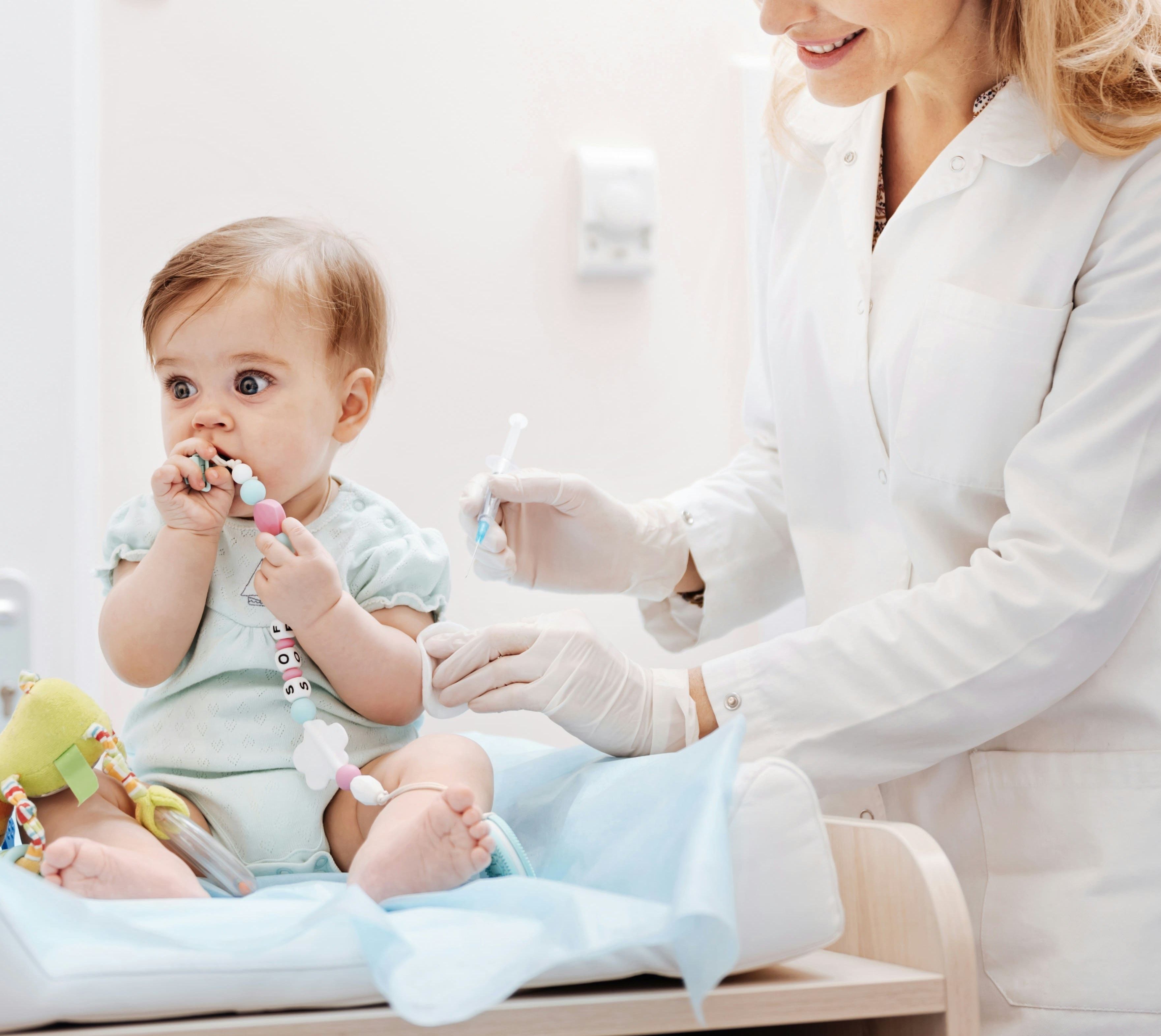
Differences in calendars in the first months of life
According to the usual "home" vaccination schedule for many, a child is supposed to receive the first dose of DPT (which protects against whooping cough, diphtheria, and tetanus) at three months.
In the UAE, the prophylactic regimen against these infections and a number of other diseases begins at two months, as part of the hexavalent vaccine. If you moved with your child around three months of age, your pediatrician will create an individualized plan.
Diana Abdrakhmanova, pediatrician at Kandinsky Clinic:
«Parents often come to me with a vaccination certificate from another country and wonder: what to do next? Figuring this out on your own is truly difficult, but our doctors help every family. We review the previous vaccinations and create a new plan—in accordance with official UAE regulations.».
What to do if your child isn't vaccinated or has missed vaccination schedules
Most vaccines are administered later in life. Even then, vaccination remains effective. The key is to not delay: the longer a child remains unvaccinated, the longer they are vulnerable. If a child misses a vaccination schedule, their doctor will create a new schedule based on local age recommendations.

Why is it dangerous to refuse vaccinations
Refusing vaccinations affects not only your child but also everyone around you—especially those who cannot be vaccinated for medical reasons: newborns, children with immunodeficiency, and the elderly.
For example, the measles virus is airborne and remains contagious for two hours after an infected person leaves the premises. A single infected person can transmit the virus to 18 unvaccinated people. Infection with measles can lead to pneumonia, encephalitis, and hearing loss.
In 2024, approximately 127,000 measles cases were recorded in the European Region—the highest number in 25 years. More than 40% of the total number of cases were children under 5 years of age. Most of those infected were unvaccinated or had unknown vaccination status.
Vladislava Tkachenko, pediatrician-neonatologist at Kandinsky Clinic:
«When parents refuse vaccinations, they often think they're protecting their children. But the risks of disease are higher than those of vaccines—this is confirmed by a comprehensive evidence base accumulated over decades.
Before deciding to refuse a vaccine, it's worth reviewing the list of complications of the disease the vaccine protects against. Measles, whooping cough, and meningitis aren't just childhood horror stories; they're real conditions that unvaccinated children face.».
The Main Vaccine Myth: Autism
Perhaps the most persistent fear among parents is the myth that vaccines can cause autism spectrum disorder (ASD). One of its progenitors was physician Andrew Wakefield, who in 1998 published a study in The Lancet that allegedly linked the measles, mumps, and rubella vaccine to ASD. The data was later revealed to be falsified: The Lancet retracted the publication in 2010, and Wakefield lost his medical license.
Dozens of large studies (including a Danish cohort study involving over 650,000 children) have found no link between vaccines and ASD. The full scientific evidence from the WHO and other leading medical organizations is now unequivocal: vaccines do not cause ASD.
Using this myth as a basis for refusing vaccinations means exposing a child to real risk.
Vaccinations at Kandinsky Clinic
Kandinsky Clinic is one of the largest Russian-speaking clinics in Dubai with a fully-fledged pediatric department. Pediatricians, a neonatologist, a pediatric pulmonologist, an allergist, a speech therapist, a psychologist, a physiotherapist, and other specialists work here. All this allows for comprehensive monitoring of your child's health, from birth through adolescence.
The clinic offers preventive vaccinations from the list of mandatory and recommended in the UAE. The clinic's specialists will help you compare vaccination schedules in different countries and answer all your questions, including why your child needs a particular vaccine.
To avoid having to keep track of checkups and vaccinations yourself, Kandinsky Clinic offers an annual medical care program for children aged 0 to 1 year or 1 to 2 years. This is essentially a medical subscription: the doctor plans your next visit, maintains a vaccination schedule, and reminds you of every vaccination, routine examination, and test.
Parents can relax completely and not worry about the vaccination schedule—the clinic's specialists will take care of everything.
For consultations and appointments with a pediatrician, please contact WhatsApp at +971555660877 or the clinic at +97145631200.
Sources:
- WHO. Vaccines and Immunization
- The National Immunization Policy of the United Arab Emirates
- Shattock AJ, et al. Contribution of vaccination to improved survival and health: modelling 50 years of the Expanded Programme on Immunization. The Lancet, 2024
- Statement of the WHO Global Advisory Committee on Vaccine Safety (GACVS) on vaccines and autism, 2025
- Hviid A, et al. Measles, Mumps, Rubella Vaccination and Autism. Annals of Internal Medicine, 2019
Disclaimer: The information in this article does not constitute medical advice. For all questions regarding your child's health and vaccinations, consult your doctor.