Laryngitis: Symptoms and Treatment in Adults

Treatment of laryngitis in adults depends on the nature of the disease. It can be associated with a viral or bacterial infection, as well as mechanical or chemical irritation of the larynx. The symptoms are largely similar, regardless of the cause. These include hoarseness or complete loss of voice, sore throat and irritation, dry cough, and a feeling of tightness in the larynx area.
What is Laryngitis?
Laryngitis is an inflammation of the mucous membrane of the larynx and vocal cords, which changes the voice, up to a complete loss of sound. Laryngitis can occur in isolation or as part of a broader respiratory tract infection in adults. It most often resolves on its own within a week but sometimes requires medical attention.

Causes of Laryngitis
In most cases, laryngitis is caused by a viral infection — the same viruses that cause the common cold (ARVI). Less commonly, the cause is a bacterial infection such as streptococcus, haemophilus influenzae, or moraxella. Viral laryngitis and bacterial laryngitis require different treatment approaches, making it important to identify the source of the disease.
Besides infections, laryngitis can also be caused by non-infectious factors:
- Vocal cord strain — excessive vocal load in singers, teachers, and speakers.
- Reflux disease — stomach acid backing up irritates the laryngeal mucosa.
- Smoking and inhalation of irritants — tobacco smoke, chemical fumes, dry air.
- Allergic reactions to dust, animal dander, or household chemicals.
Symptoms of Acute Laryngitis
Symptoms of acute laryngitis develop quickly, usually against the background of a cold. They include:
- Hoarseness or complete loss of voice.
- Sore throat, irritation, feeling of dryness.
- Dry cough that later becomes wet with phlegm.
- Fever (usually mild).
- Discomfort when swallowing.
- Sensation of a lump in the throat, frequent desire to clear the throat.
In some patients, laryngitis may be accompanied by a barking cough. This condition requires special attention, as in rare cases, it can lead to breathing difficulties.
Gulnaz Toksanbayeva, ENT doctor at Kandinsky Clinic:
«In my practice, I often hear: my voice disappeared suddenly, literally within a few hours. This is a typical picture of acute laryngitis. There is no need to be alarmed — in most cases, this condition resolves on its own. However, if hoarseness persists for more than two to three weeks, it is a reason for a more thorough diagnosis to rule out other causes.».
Treatment of Acute Laryngitis
Treatment for acute laryngitis does not require antibiotics in most cases. According to data from the Cochrane Review, antibacterial therapy has not shown objective improvement in adults with acute laryngitis. In the vast majority of cases, drugs are ineffective because the illness is caused by a virus.
What is effective for viral laryngitis:
- Voice rest.
- Humidifying the air and the mucosa (using a humidifier or nebulizer with saline solution).
- Plenty of warm fluids.
- Avoiding smoking and alcohol — both factors increase inflammation.
Rest and humidification are simple home treatments that provide quick relief for most people.
Treatment for viral laryngitis is usually limited to symptomatic remedies: fever-reducing tablets if the temperature rises, and over-the-counter lozenges or sprays to relieve sore throat pain. Specific antiviral drugs are generally not prescribed for this form of laryngitis.
Acute vs. Chronic Laryngitis: What is the Difference?
Laryngitis can occur not only in an acute form but can also become chronic — and it is treated differently. According to the StatPearls (NCBI) medical reference, if inflammation of the larynx persists for more than 3 weeks, the condition is classified as chronic laryngitis. For clarity, the main differences are presented in a simple table:
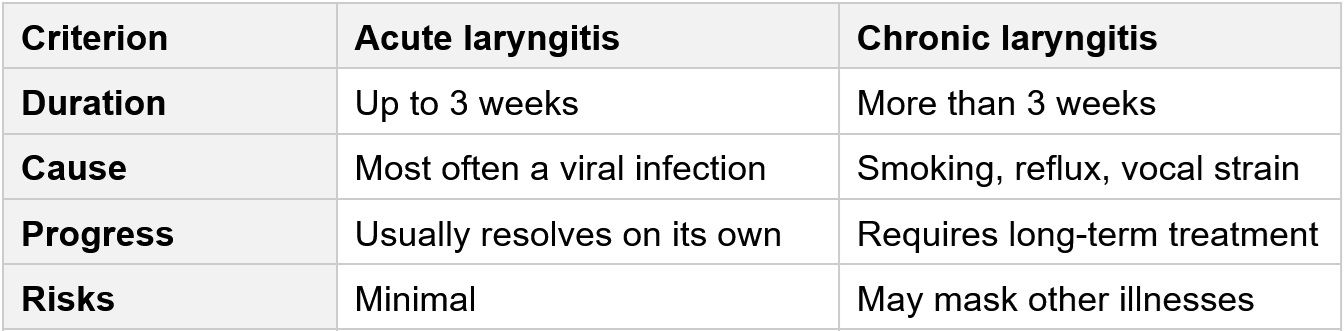
The acute form of laryngitis is more often associated with a viral infection, while the chronic form is linked to smoking and other non-infectious factors. Chronic laryngitis can mask more serious diseases of the larynx, so it is important to see a doctor for an examination if hoarseness persists.
Forms of Laryngitis by Nature of Inflammation
Besides the division into acute and chronic, laryngitis is distinguished by the nature of changes in the mucous membrane:
- Catarrhal — the most common form. The mucosa becomes red and swollen, but its structure does not change. This form occurs in most viral laryngitis cases.
- Atrophic — the mucosa thins and becomes dry. It often develops against the background of long-term smoking, working in polluted air, or after repeated episodes of acute laryngitis.
- Hypertrophic — the mucosa, conversely, thickens, and nodules may appear on the vocal cords ("singer's nodules" or "screamer's nodules"). It is typical for people with excessive vocal load — singers, teachers, announcers.
Atrophic and hypertrophic forms usually belong to chronic laryngitis and require longer observation by an ENT doctor.
Treating Laryngitis at Home: Do's and Don'ts
If laryngitis occurs without complications, it is treated at home in most cases. Here is what you can do at home:
- Drink warm (not hot) beverages to reduce irritation and swelling of the mucosa.
- Use saline solution inhalations.
- Give your voice a rest — minimize talking for 3–5 days, and also avoid whispering, as it strains the voice.
- Humidify the air and avoid polluted, especially smoky, environments.
- Do not self-medicate with antibiotics.

When a Doctor May Prescribe Antibiotics
Antibiotics are prescribed only for a confirmed bacterial infection — for example, if symptoms do not resolve within 7–10 days, purulent sputum appears, or a high fever persists for a long time.
The decision is always made by a doctor: you should not take antibiotics on your own, as they are effective only against bacteria and can cause side effects without real benefit.
When to See a Doctor
Seek medical help if:
- Hoarseness does not disappear for more than 3 weeks.
- It is difficult to swallow, including saliva.
- There are whistling sounds when breathing in.
- A temperature above 38.5°C persists for three days or more.
- Blood appears in the sputum.
- The voice is completely gone and does not recover for more than a week.
It is especially important not to delay a visit if signs of breathing difficulty appear. This may indicate laryngeal edema — a condition requiring immediate medical attention.
Prevention of Laryngitis
Prevention includes several simple measures: avoid vocal strain, do not smoke, humidify indoor air, and promptly treat colds (ARVI) and reflux disease if diagnosed.
Laryngitis, Pharyngitis, Tonsillitis: How to Tell Them Apart
The symptoms of these three conditions are often confused, as they all cause a sore throat. However, they affect different structures:
- Laryngitis — inflammation of the larynx and vocal cords. The main sign is hoarseness or loss of voice.
- Pharyngitis — inflammation of the pharyngeal mucosa. The main sign is a sore throat when swallowing; the voice usually does not change.
- Tonsillitis — inflammation of the tonsils. It is often accompanied by high fever, coating on the tonsils, and swollen lymph nodes.
Sometimes these conditions combine — for example, a viral infection can cause pharyngolaryngitis.
Laryngitis in Pregnant Women
Laryngitis occurs quite often during pregnancy — due to natural changes in the immune system, as well as increased pressure in the abdominal cavity, which exacerbates reflux disease. The condition itself is not dangerous for the pregnancy.
An important difference in treatment is that many medications usually prescribed for laryngitis are contraindicated for pregnant women. It is recommended to consult a gynecologist or ENT specialist to select safe therapy.
Psychogenic Aphonia: When the Voice Disappears Without a Physical Cause
Sometimes the voice disappears not because of an inflammatory process, but against the background of severe stress, anxiety, or emotional shock — this is called psychogenic aphonia. Upon examination, the vocal cords look absolutely healthy, but the voice is absent or severely weakened.
This condition is not very common, but it is important to distinguish it from true laryngitis, as the treatment is fundamentally different — it requires working with the psycho-emotional state, sometimes with the participation of a psychotherapist. An ENT doctor can rule out organic causes during an examination and refer you to the right specialist.

Diagnosis and Treatment of Laryngitis at Kandinsky Clinic
At Kandinsky Clinic in Dubai, ENT doctors diagnose laryngitis using modern equipment, including laryngoscopy — an examination of the larynx and vocal cords. This is especially important for persistent hoarseness to promptly distinguish ordinary laryngitis from other conditions requiring specific therapy.
We work according to the principles of evidence-based medicine: we prescribe only those examinations and drugs whose effectiveness is confirmed by clinical data.
If additional tests are needed to clarify the diagnosis, they can be taken in the clinic's own laboratory — results are usually ready quickly, without the need to travel elsewhere and waste time waiting.
You can make an appointment with an ENT doctor in Dubai and ask additional questions via WhatsApp at +971555660877 or by calling the clinic at +97145631200.
Sources
- Cochrane Database of Systematic Reviews. Antibiotics for acute laryngitis in adults
- MSD Manual Professional Edition. Laryngitis
- StatPearls (NCBI). Acute Laryngitis
- PubMed. Acute Laryngitis
- Swain S.K., Pattnaik T., Acharya S. Laryngeal Manifestations in Pregnancy: Our Experiences at a Tertiary Care Teaching Hospital of Eastern India. Annals of Indian Academy of Otorhinolaryngology Head and Neck Surgery, 2020
Author: Gulnaz Toksanbayeva, ENT doctor at Kandinsky Clinic, 7 years of experience (DHA License: No. 80101836-001) Medical Editor: Olga Polikina, Chief Physician of Kandinsky Clinic, Candidate of Medical Sciences (DHA License: No. 08705887-001) Material Review Date: 03.09.2026 Disclaimer: The information in the article is not medical advice. For all questions, consult a doctor.